How Independent Businesses Give a Neighbourhood Its Character
There's a particular kind of recognition that happens when you walk into a place that feels like it belongs exactly where it is. Not designed for everywhere, but built – consciously or not – for here.
That feeling is what independent cafés and shops quietly produce. A family-run Ethiopian café in a corner unit doesn't just serve food; it signals something about who lives nearby, what they value, and how the street has changed over time. The handwritten specials board, the owner who remembers your usual order, the photographs of a distant city on the wall – these details accumulate into something a franchise location simply cannot manufacture.
Everyday Landmarks That Shape How We Experience a Place
Ask anyone to describe their neighbourhood and they'll almost always reach for a local business. The bakery that opens at six. The bookshop with the dog who sleeps near the door. These places function as informal landmarks, giving residents a mental map of where they live that goes well beyond street names.
Newcomers use them the same way. Walking into an independent shop in the first week of living somewhere tells you more about a neighbourhood's character than any estate agent's brochure. You pick up the pace of the place, the tone of conversation, the sense of who is welcome.
Rituals, Regulars, and the Feeling of Belonging
Chain businesses can be reliable, even comfortable. But reliability isn't the same as belonging. What independent businesses create – almost accidentally – are rituals. The Thursday morning table claimed by the same four retirees. The Saturday queue at the deli that somehow becomes a neighbourhood catch-up. These small, repeated interactions are how people actually form attachment to where they live.
Some might argue this is sentimental, but urban researchers have documented it plainly. Ray Oldenburg's concept of the "third place" – somewhere that is neither home nor work – describes exactly this function. Independent shops fill that role in a way that feels organic rather than engineered, and that difference is something residents notice, even if they never quite name it.
Where the Money Goes When People Buy Local
Spend money at an independent café and it starts moving in ways most people never think about. The owner pays wages to staff who live nearby. She buys milk from a regional dairy, gets the espresso machine serviced by a local engineer, and when the roof leaks, she calls a plumber two streets over. Each of those transactions supports another business, another household, and another set of decisions made close to home.
Economists call this the local multiplier effect, though you do not need the jargon to understand the logic. Money that continues circulating within a neighbourhood can contribute more to the local economy than money that quickly leaves it. A 2012 study by the New Economics Foundation found that spending with local businesses generated substantially more value for the surrounding economy than equivalent spending with large chains. That difference can become significant when repeated across thousands of everyday purchases.
Chains operate differently, and there's no denying the model is efficient for them. Purchasing is centralised, often handled at a national or international level. Profits flow upward to shareholders who may have no connection to the area whatsoever. Even the staff wages, while real, tend to be set by distant HR policies rather than negotiated with any awareness of local conditions. The economic relationship between a chain and its host neighbourhood is thin by design.
An independent business owner, by contrast, has skin in the game. Her children go to the local school. She uses the nearby GP. When the high street suffers, she suffers. That proximity shapes how she spends – on suppliers, on maintenance, on the small decisions that quietly keep money circulating in the area.
Buying local is sometimes framed as a lifestyle choice, something warm and sentimental. That framing undersells it. Redirecting spending toward independent businesses is one of the more direct ways ordinary residents influence the economic health of the place they live.
Why Small Storefronts Matter as Everyday Social Infrastructure
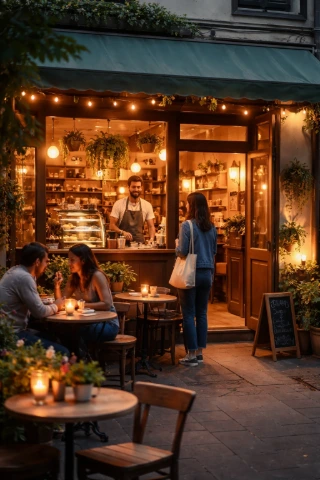
Think about the last time a stranger smiled at you and meant it. Chances are it happened somewhere small – a counter, a queue, a neighbourhood café where the staff already knew your order. Those moments feel minor, but they're doing something that urban planners have spent decades trying to understand and replicate.
The Informal Public Space Nobody Planned For
Sociologist Ray Oldenburg called places like these "third places" – not home, not work, but somewhere in between that holds a community together without anyone noticing. A good café or corner shop functions as exactly that. You don't need to book it, justify your presence, or spend much to belong there. You just show up, and the place does the rest.
This matters enormously for groups who often fall through the cracks of formal community life. Older residents who live alone may go days without meaningful conversation unless a familiar shopkeeper asks how they're doing. Remote workers, who now make up a significant share of the workforce in most cities, frequently name a nearby café as their main source of daily human contact. Parents with young children rely on pram-friendly local spots not just for coffee, but for the adult conversation that makes a long Tuesday bearable.
Teenagers need these spaces too, though they're rarely designed with them in mind. A welcoming café or independent record shop gives young people somewhere to exist in public without being treated as a problem.
Streets That Feel Lived In
There's no denying that active storefronts also change how safe a street feels. Jane Jacobs wrote about "eyes on the street" back in 1961, arguing that busy, mixed-use neighbourhoods are self-policing in a way that empty ones never can be. A shuttered main street signals neglect. An open one, with light spilling from a window and people moving in and out, signals that someone is here, that this place is cared for.
Thriving local businesses are social infrastructure. They're not decoration.
What Neighbourhoods Lose When Local Businesses Close
There's a particular kind of quiet that settles over a street when a long-running shop closes. The sign comes down, the windows go dark, and for a while, regular customers walk past out of habit before remembering there's nothing to stop for anymore.
The obvious losses are easy to list: fewer places to shop, fewer local jobs, one more empty unit collecting dust. But the less visible costs are often the ones that matter most. A café that has operated for fifteen years carries something no chain can replicate – the owner who remembers your name, the informal meeting point for the book club, the place where someone first heard about a local event or got a tip about a reliable plumber. When that closes, the knowledge and trust built into it simply disappears.
Shuttered storefronts also change how a street feels to walk down. Research on pedestrian behaviour consistently shows that active ground-floor retail – even modest, independent retail – encourages slower walking, more eye contact, and more spontaneous conversation between strangers. Empty windows do the opposite. They signal neglect, which discourages foot traffic, which in turn makes neighbouring businesses more vulnerable. One closure can quietly destabilise a block.
The pressures behind these closures are real and shouldn't be dismissed. Rising commercial rents in many cities have doubled in a decade. Online shopping has permanently shifted where people spend money on books, gifts, and clothing. Thin margins and unpredictable foot traffic make survival genuinely difficult, especially for sole traders without financial reserves.
Rebuilding what's lost is far harder than it looks. A new café can open in the same unit, but it takes years to accumulate the regulars, the reputation, and the informal social role that made the previous one matter. The business can be replaced. The network it held together usually can't.
A Strong Neighbourhood Needs Places That Know Its People
There's something that happens when a neighbourhood loses its last independent café. It's not just the coffee that disappears. The morning ritual goes with it, the counter where the owner remembered your name, the noticeboard with the flyer for the local school play. A chain moves in, or nothing does. Either way, something harder to name is gone.
Identity Isn't Built by Algorithms
Independent businesses give a neighbourhood its character in ways that no franchise formula can replicate. The fishmonger on Elm Street who sources from a single coastal supplier, the bookshop that stocks local history titles nobody else carries – these aren't quaint details. They're the texture of a place. Residents use them as landmarks, both physical and social. When visitors ask what makes a neighbourhood worth visiting, they rarely point to the chain coffee on the corner.
Where the Money Actually Goes
Spending locally keeps more value circulating within the community. Research from the New Economics Foundation found that money spent with local businesses can generate significantly greater value for the surrounding economy once multiplier effects are taken into account. Chains often direct profits toward shareholders and head offices elsewhere. The independent café owner, by contrast, may buy supplies from a local wholesaler, pay a nearby accountant, and hire people from the surrounding area. The money moves in tighter, more locally connected circles.
What Closes When the Storefront Does
When small shops disappear, the loss isn't only commercial. Studies of high street decline in British market towns found that residents reported reduced sense of belonging and fewer spontaneous social interactions within two years of significant independent business closures. The café wasn't just selling flat whites. It was hosting the informal conversation between neighbours who'd never otherwise have spoken.
Supporting independent businesses isn't nostalgia or sentiment. Every purchase there is a small, practical vote for the kind of place you want to live in – one that holds its identity, recirculates its wealth, and keeps the everyday spaces where community life actually happens open for everyone.
Ways Residents Can Help Local Businesses Stay Part of the Community
Independent cafés and shops often depend on steady, everyday support rather than occasional bursts of attention. Residents can help simply by making local businesses part of their normal routines, whether that means buying from a nearby bakery, meeting friends at an independent café, or choosing a local service provider before looking elsewhere.
Recommendations and honest reviews can also make a difference, especially for businesses trying to reach new residents. Constructive feedback helps owners understand what customers actually need and where improvements could be made.
Supporting local businesses does not mean ignoring price, quality, or service. Loyalty works best when it is earned. When residents value useful local places and businesses respond to the community around them, neighbourhoods are more likely to retain the familiar shops, cafés, and services that give everyday life its character.